Separating what candidates think of the brand from how the recruiting process actually performs

The Challenge
For a top global management consulting firm, the annual campus recruiting cycle is a brand competition with an unusually clean scoreboard: candidates holding offers from more than one firm have to pick one.
The firm needed to understand why those decisions went the way they did — and to separate two things that are easy to confuse. Is a candidate choosing a competitor because of what they believe about that firm’s brand? Or because of something that happened during the process — a conversation that did or didn’t take place, a touchpoint that landed or didn’t?
Those diagnoses lead to completely different responses. One is a positioning problem. The other is an execution problem, and often a much cheaper fix. Getting it wrong means spending a year solving the wrong thing.

Our Approach
We built the survey around candidates holding competing offers — the ones who actively chose between firms — because that’s the only genuine apples-to-apples comparison available. The broader offeree base gave scale where every candidate’s view mattered.
The instrument covered three connected areas: brand perceptions of all three firms, the candidate experience stage by stage, and post-offer decision drivers. We asked candidates to reconstruct their relative interest in each firm at five points in the journey, which turns a single outcome into a curve — showing exactly where you gain ground and where you lose it.
Two analytical moves did the heavy lifting. First, importance-versus-performance mapping, run separately for candidates who accepted and those who declined, so strengths, barriers and misallocated effort could be told apart. Second, coded open-ends in candidates’ own words, where the reasons behind the ratings live.
Because this is a repeat engagement, every result is read against the prior year [verify: how many consecutive years?]. We were also explicit about base sizes, flagging every cut too small to analyze.
What We Uncovered
- Three distinct brand personalities in candidates’ unaided words — and a read on which associations the client owns, which a competitor owns, and which are contested.
- What candidates actually weigh when choosing between firms, ranked, and how that differs between those who accepted and those who walked.
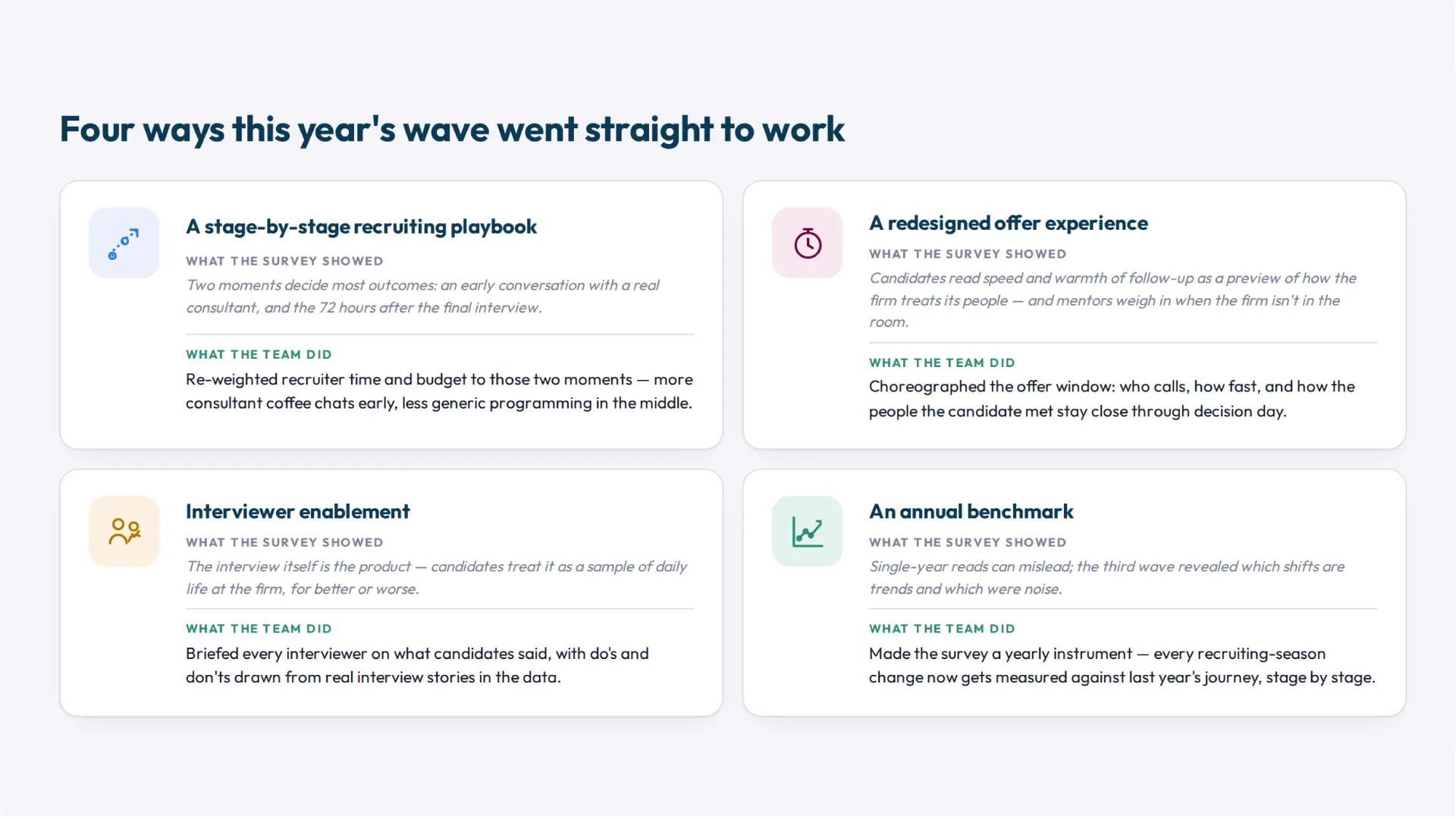
- A stage-by-stage view of the journey showing where the firm builds an advantage and where its lead flattens.
- An execution detail in the interview experience that candidates weighted far more heavily than the firm expected — a fixable operational issue with a measurable competitive cost.
- What competitors do after an offer is extended that moves decisions — and the size of the underlying differentiation problem, in candidates who see no real difference between the firms on the benefits that matter most.
The Impact
The firm ended the cycle able to tell a brand gap from a process gap — and to point at each one specifically, with candidates’ own language attached.
Because the study repeats annually, the outputs do double duty: a decision tool for the coming season, and a baseline for whether last season’s changes worked.
Key Takeaways
- Find your cleanest comparison and build around it. Candidates who chose between offers beat a bigger, muddier sample.
- Track interest across the journey, not just the outcome. A five-stage curve tells you where to intervene; a final result only tells you that you should.
- Flag small bases loudly. Being explicit about what the data can’t support earns trust in everything it can.


Default Rich Text Content
This is the default rich text value
Default Rich Text Content
This is the default rich text value






We’re trusted by some of the best


